Ages: 5-7
Contributor:
Nicki Parsons
Contributor:
Nicki Parsons
A simple table which children can use to record their own practical measurements.
Ask your students to choose a selection of items, estimate their lengths and then measure them!
A simple table which children can use to record their own practical measurements.
Ask your students to choose a selection of items, estimate their lengths and then measure them!
I have made these cards for my Year 2 class, but all of the staff at my school can see the potential for using them with all primary-age children.
They are very simple cards with “yes” on one side and “no” on the other. Each child should have one of each card. They can be used during the oral and mental starter of the numeracy hour.
The children can have an interactive session, and it provides me with a useful on-the-spot assessment.
The teacher should ask the class a question, and children hold up their cards with the correct side facing the teacher. Examples of questions you might ask include:
“Is this number…
odd? even? a multiple of 10? a multiple of 5? a multiple of 2? a multiple of 4? a ten? a unit? a hundred?”
The possibilities are endless…

Buy This Book * More books by H. S. Toshack
A clever and cheeky little black and white cat who sneaks off on an African safari with the Allen family… Her journey into the heart of Baragandiri in search of the Allens, after she has become separated from them…Terrifying encounters (mainly involving teeth) with the wild animals there- Nyanya, an old but ferocious lioness, who plans to attack Thomas and Amy, the Allen children, while they are asleep in their tent-,,,Only Sheena can save the children. But first she must find them.


Contributed by Janet Gould

Contributed by Janet Gould
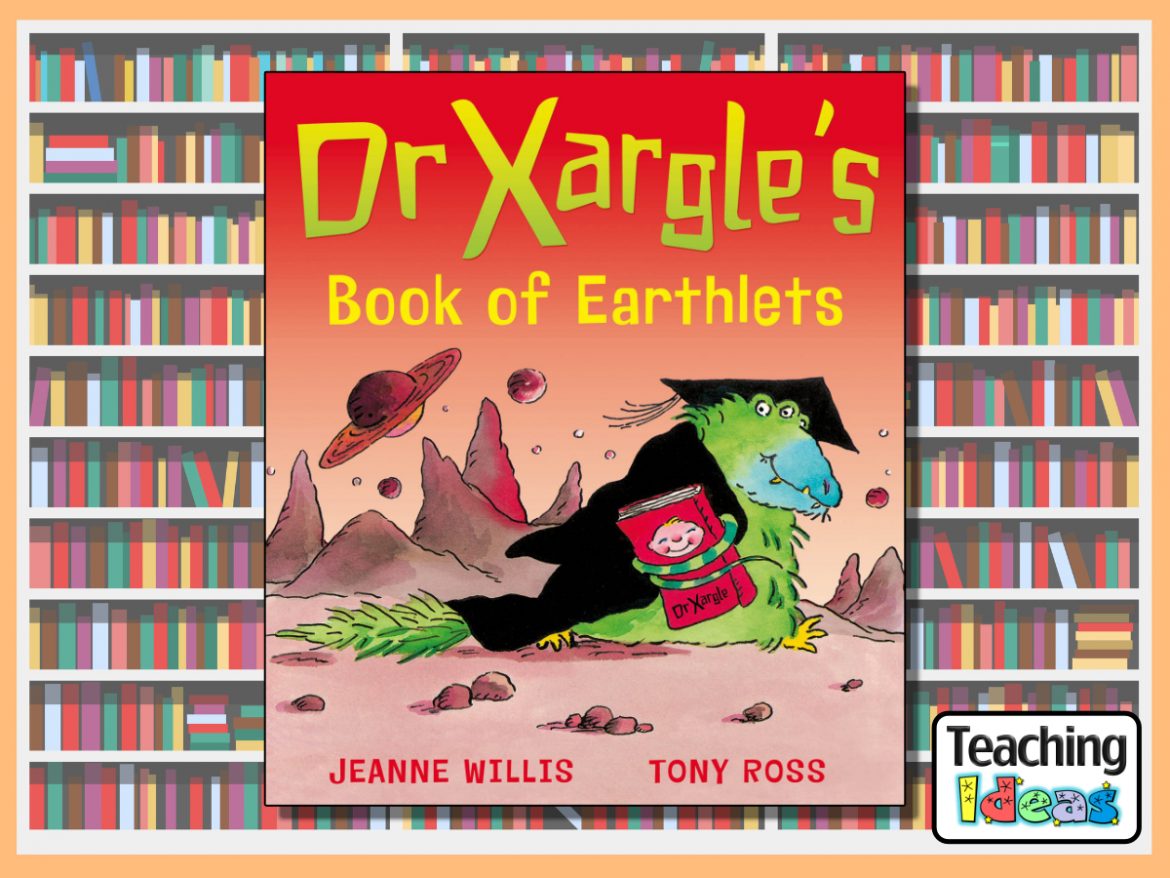
Buy This Book * More books by Jeanne Willis
“Good morning, class. Today we are going to learn about Earthlets. They come in four colours. Pink, brown, black or yellow . . . but not green.” In this way, Dr Xargle, our friendly alien teacher, begins to teach his class about humans and babies. This is an hysterically funny book, with a particularly wry look at our natural methods and practices in bringing up babies: look out for the ‘egg-mangle’ – will you ever want to eat it again?
In the hall / gym, split the children into two groups and then number them. For example, if there are 20 students in the class, split them into groups of ten, then number each student from 1-10.
Have them sit on opposites sides of the hall / gym, then call out a number, i.e. 3
Both number threes will get up and run to the middle of the hall where a duster (preferably a soft one, not one with a hard back) and two newspapers rolled up (the hockey sticks) are waiting. Each child takes a newspaper stick and tries to hit the duster into their goal.
If someone scores, another number is called out, and the next two will have a go. If no one scores after a few minutes to make sure everyone has a go, call out another number, and the ones playing must drop their “sticks” where they are and the next students have a go.
This can also be played in pairs when the teacher calls out two numbers etc.

Buy This Book * More books by Anthony Browne
Once upon a time, there lived a brother and sister who were complete opposites and constantly fought and argued. One day they discovered the tunnel. The boy goes through it at once, dismissing his sister’s fears. When he doesn’t return, his sister has to pluck up the courage to go through the tunnel too. She finds her brother in a mysterious forest where he has been turned to stone…

Buy This Book * More books by Julia Jarman
Ben and Bella are having such a lovely, splashy time in the big red bath that soon everyone wants to join in the fun! But will there be room for all the animals… even Hippopotamus?
This activity is based on a worksheet which can be found below.
The worksheet asks the children to label the different parts of the plant. The answers are as follows:
Diagram 1 – 1) Leaf, 2) Stem, 3) Root,
Diagram 2 – 4) Petals, 5) Pistil, 6) Filament, 7) Sepal, 8) Stem
When the children have done this, they are asked to write down the functions of the roots, stem, leaves and flowers.
This worksheet can be used in a number of contexts:
1) It is an ideal task to give the children to assess their knowledge and understanding at the end of a period of work on plants.
2) It can also be used as a research task. Give the children the worksheet and ask them to find out the answers using different reference materials (books, CD-ROMs etc.).
3) Give the sheet to the children, and discuss the parts (and their functions) of the plant. While you are explaining the topic, they can fill in the sheet and keep it for reference.
4) Make an interactive display board. Enlarge one (or both) of the pictures on the sheet, and stick the enlarged copy onto a display board. Make some labels (with the names of the plant parts on), and stick some Blu-Tack to the back of them. The children can now interact with the display by placing the labels over the correct parts of the plant.

Buy This Book * More books by Claire Freedman
Aliens love underpants, It’s lucky that they do, For pants helped save our universe, Sounds crazy, but it’s true! Aliens in underpants are back – and this time, they are on a mission to save the world!
A gigantic meteorite is heading for planet earth and the aliens’ pants supply is under threat. Can our crazy aliens save planet earth and secure their pants supply forever more?

Buy This Book * More books by Emily Gravett
Sunny the meerkat lives with his enormous family in the Kalahari desert. They are all very close . . . so close, in fact, that one day Sunny decides it’s just too crowded and packs his bags. He’s off to visit his mongoose cousins. But from the watery world of the Marsh Mongoose to the nocturnal lifestyle of the Malagasy Mongoose, Sunny just doesn’t fit in. And who’s that shadowy figure who seems to be following him around?


