Develop your children’s handwriting skills and knowledge of shapes with our free printable monster shape tracing sheet. Can your children create some wild and wonderful monsters when they have traced the shapes?
A poster that shows a range of vocabulary linked to division.
We also have similar posters, covering addition, subtraction and multiplication.
Downloads:
Buy This Book * More books by Mini Grey
With an action outfit for every occasion, Traction Man patrols the house. Whether he is saving toys (in latex space suit and Perspex helmet, teamed with Rocket Boots); searching the sink for the lost wreck of the sieve (in sub-aqua suit, fluorescent flippers and infra-red mask) or rescuing damsels in distress (in jungle pants, camouflage vest and a bandanna), Traction Man is never less than stylishly turned out and expertly accessorised. He is the last word in heroic fashion flair – until, that is, the day that he is presented with an all-in-one knitted green romper suit and matching bonnet by his owner’s granny.
Can Traction Man overcome the humiliation of his desperately dowdy new look and rediscover the action hero within or will the burden of the knitted green monstrosity be too great?
Teaching Ideas and Resources:
English
- The inside cover shows a letter from Traction Man’s owner to Santa, explaining that his old Traction Man had a ‘Terrible Parachute Accident’. Can you write a story about this to explain what happened?
- Write a letter from the boy to Santa to say ‘Thank you’ for the new Traction Man toy.
- Retell the story from Traction Man’s point of view.
- Create a written, radio or video advert to persuade children to buy a new Traction Man toy.
- Traction Man uses everyday household objects to carry out his adventures. Think of other objects and make a list of ways that Traction Man could use them… or ways that they could cause problems for him!
- Choose one of the pictures and think of a caption to describe what is happening.
- Traction Man’s Warfare Shirt is covered in examples of onomatopoeia. Can you think of any more?
- Write a story about a new Traction Man adventure, e.g. Traction Man repairs the Giant Intergalactic People Mover.
- Create character profiles for all of the characters in the story, including the boy and his family.
- Find the descriptive language used in the story (e.g. foamy waters, supersonic, hoist) and use this to create a collection of vocabulary that you can use in your own writing.
- Make a set of instructions to teach people how to look after a pet scrubbing brush.
- Carry out some drama activities based on the story. Could you perform part of it… or try some hot-seating to ask ‘Traction Man’ some questions?
- At the end of the story, an evil pair of scissors is approaching Traction Man and Scrubbing Brush. Can you write about what happens next?
Maths
- Research different action figures that are available for sale in local shops / online. Make a table to show the features and prices. Use sorting diagrams to compare them. Carry out a survey to find out which one(s) people prefer.
Computing
- Make a video trailer to promote the Traction Man series of books.
- Make a website to advertise the books.
- Create your own video retelling of the story. Watch these examples:
- Find an action figure and use it to create a Traction Man stop motion animation or video. Watch this example for inspiration:
Design Technology
- Make your own model of Traction Man and / or Scrubbing Brush.
- Design (and make) a set of new costumes for Traction Man. Use the Character outlines below to plan your designs.
- Design and build a box for a new Traction Man action figure or accessory.
- Find out about the materials that are used to make different kinds of toys.
Art
- Explore Mini’s Sketching Weakly blog. Can you challenge yourself to complete a weekly sketching challenge? Could your work be shared with others on a blog or other space?
- Create a storyboard to outline the plot of a new Traction Man movie.
- Design a sidekick (or a family) for Traction Man.
- Traction Man’s enemies are everyday objects (e.g. a poisonous dishcloth, the Wicked Professor Spade). Can you design a new enemy for him?
Music
- Compose the theme tune to a new TV series about Traction man.
Geography
- Create a map of the house and label it to show the different adventures that Traction Man has in each part.
History
- Find out about the history of action figures and other kinds of toys.
PSHE
- Create a set of speech / thought bubbles for Traction Man at different points in the story to explain how he is feeling. Can you tell by his facial expressions and body language?
Downloads:
The following activities give children opportunities to make maps and plans at a variety of scales:
1) Plan Views of Objects
Ask the children to draw plan views of normal classroom objects. This can be done by:
- Looking at the object from above and drawing what you can see, or…
- Placing the object on an overhead projector and drawing around the silhouette which is projected.
2) Classroom Map – KS2 (Ages 7 to 11)
Make a map of the classroom showing the layout of tables and chairs. For younger children, the next activity may be more appropriate.
3) Classroom Map – KS1 (Ages 5 to 7)
Make some rectangles out of card. The rectangles represent tables, so you will need to make enough rectangles for the number of tables in your classroom. Draw a basic outline of the shape of the classroom on a piece of paper, and ask the children to arrange the rectangles on the paper so that they match where the tables are found in the classroom. You could also make other shapes to represent the board, computer, teacher’s desk etc.
When the children have put the shapes into the correct space, they can draw around the shapes, and they will produce a map of the classroom.
4) Sign Posts
Ask the children to draw a signpost showing where things are in relation to where they are sitting. For example:

The arrows indicate the location of the objects / people in relation to the child (labelled “Me”). The length of the arrow indicates the distance between the child and the object / person. The children could make their signposts more interesting by using pictures instead of words.
5) Aerial Photos
If you have any suitable aerial photographs, ask the children to try and draw a map for the area shown on the map. This can be done by simply looking at the photo and reproducing the shapes onto paper or by laying a piece of transparent film (OHP film) over the photo and tracing over the main shapes, using a suitable pen (which will not rub off).
Google Maps has an excellent aerial photo facility. If you have an interactive whiteboard, you could draw over the top of the map using the whiteboard pen tools. You could then compare this to the street map overlay, which Google provides.
Contributor:
Lucy Forbes
To develop cooperation and teamwork skills, you only need a playground/empty school hall and a big ball of string.
Stand the class in a circle. Hand the ball of string to the first person, who rolls it across the floor (keeping hold of the end) to someone on the other side of the circle. That person rolls it to someone who hasn’t had the string yet, and so on, until everyone has caught the string once. You will have formed a large ‘spider web’ with the string. (It is important all children only catch the string once).
The last person to end up with the ball of string has to trace it back to the first person, climbing under and over the threads of the web, with the others lifting and lowering their threads to help him.
They must listen to each other across the circle as they figure out how to undo the web.
Buy This Book * More books by Louis Sachar
“Give me a dollar or I’ll spit on you.” That’s Bradley Chalker for you. He is the oldest child in the class. He tells enormous lies. He picks fights with girls, and the teachers say he has “serious behaviour problems.” No one likes him – except Carla, the new school counsellor. She thinks Bradley is sensitive and generous, and she even enjoys his far-fetched stories. Carla knows that Bradley could change, if only he weren’t afraid to try. Sometimes the hardest thing in the world is believing in yourself.
Teaching Ideas and Resources:
English
- Read the text together. Discuss the characters / settings / events. Identify any unusual words… there are many American words in the story which children outside of America may be unfamiliar with. Make a glossary of these words.
- Look at these images. They show the most common words from the first two pages in the book, and from Chapter 1. What do they tell us about those parts of the book? Which words appear most often? Why? What types of words are they (nouns / adjectives etc.)? You can make images like these by pasting your own text into?www.wordle.net.
Pages 1 and 2:

Chapter 1:

- Make a diary from Bradley’s point of view. What thoughts and feelings would he include? How would he present the diary – in a neat and tidy way, or scruffy and messy?
- Make a diary from Jeff’s point of view. What would he say about Bradley and the events of the story? How would his diary be different from Bradley’s? Why?
- Billenda Hemeyer has suggested the following idea:
- ‘I have been using this book for the last five years in fourth grade. Every year we stop at the point where Bradley thinks he’s a monster and the kids in groups draw life-size posters of monsters, with a red heart in the middle. They then write an ‘I Am’ poem from his point of view. At the end of the book we do the same thing, only this time Bradley is a regular looking boy with a big smile. Then we do another ‘I Am’ Poem. It beautifully shows the profound changes Bradley Chalkers goes through!’
- Use the images provided below to support your diary writing. You could also try adding speech / thought bubbles to each picture to show what each person is thinking / feeling. A tool like Voicethread could also be used in a similar way.

These images were created by Helen Warner and are available to download below.
- Hotseating – Take on the role of one of the characters and ask other children to interview them about the events of the story.
- Conscience Corridor – Split the class into two groups and have each group form a line which faces the other. Have one child take on the role of Bradley and get him / her to walk down the ‘corridor’ in between the lines. ‘Bradley’ should ask each person a question about what has happened to him in the story, e.g. Should he go and see Carla today? What should he say to Jeff when he sees him next? How can he get Mrs. Ebbel to like him?
- Choose one of the chapters and rewrite it as a storyboard / script which the children can then perform. These could be recorded and played back for evaluation.
- Make a character profile about each person in the story. What do they look like? What are their personalities like? What kinds of things do they say? How do other people respond to them?
- When you reach the end of the story, think about how each of the characters has changed. When / how / why did these changes take place? What did each character learn?
Computing
- Use email to interact with the characters. If possible, the teacher can set up an email account for ‘Jeff’. The pupils could then send emails to Jeff at this address with the teacher responding in role as the character. Children could ask Jeff how he feels about particular events in the story, or give him advice about how he can help Bradley. A child could also take on the role of Jeff and write appropriate responses.
- Make a Powerpoint story – The Powerpoint presentation below has a selection of images which are based on the events of the story. Can children add their own text to explain what is happening? Weaker writers could use the audio recording options within Powerpoint to tell their version of the story and then play this back later.
- Jen Kenny suggests… Get the children to create a trailer for the film of the book, so they have to pick out key moments without giving away too much of the plot. They could use movie maker to do this, using drawn images, images from the net or digital camera photos.
PSHE
- The story is also a great starting point for discussions about PSHE and bullying. How does each character in the story behave and how does this influence how others treat them?
- Brian has shared the following suggestion:
- ‘Listen to the song “I am a rock” by Simon and Garfunkel. I can’t recall at which chapter I played it for my students, but I do recall the hair standing up on the back of my neck. Students can do a number of higher order activities analyzing, comparing, and connecting the song to the book.
- The book can be a wonderful springboard for discussions and activities that help students to better understand their feelings. Depending on their maturity, they may begin to understand the motivations behind the actions of others. Between this book and the poem, “Our Greatest Fear,” a teacher can really help young people better understand themselves and each other. Those activities helped me to have the most amazing years of my career in the classroom.’
Downloads:
Buy This Book * More books by Emma Chichester Clark
Piper is a gentle dog, courageous and anxious to please. It’s very unfortunate that he is bought by a grim man who tells him to ‘take care of the rabbits’. Piper babysits them beautifully, which is not what his new owner meant at all, and loses him his dinner. He runs away to the big city, and saves an old lady from being run over, but he hurts his leg doing it, and the old lady is still taken to hospital. It takes persistent passers-by to find him and take him to the vet, and all is well in the end.
Teaching Ideas and Resources:
English
- Think of vocabulary to describe Mr. Jones and / or his crooked house on the hill.
- Rewrite the story from Piper’s point of view.
- Brutus has ‘teeth like knives’. Can you think of different similes to describe Piper / Mr. Jones / Brutus.
- Write the conversation that Brutus and Piper might have when they first meet.
- Piper is ‘terrified’ when Brutus arrives. Can you think of synonyms for ‘terrified’?
- Write a story about what happens to the old lady and Piper after the end of this story.
- Write a new story about a heroic dog (see Resources below).
Science
- Think about the different types of habitat featured in the story, e.g. countryside, river, and city. How are they similar / different? What different types of animals live there?
Computing
- Use publishing software to make a poster that promotes this book to others.
- Make an animation that retells part of the story.
Art
- Look at photos of dogs and use these as the starting point for your own drawings (see Resources below).
- Some of the illustrations are bright and colourful but others are dull and gloomy. Can you draw two illustrations? one of which is bright and another that is dull?
- Draw a picture of what it might look like inside Mr. Jones’ house.
- Choose an illustration and redraw it, showing what it might look like from Piper’s point of view.
Geography
- Draw a map showing the different places in the story.
- Piper ‘plunged across a river’ in the story. Can you find the location of any rivers near to where you live? Where do the rivers flow to / from?
- The city is full of smoke from cars and chimneys. Can you think of ways to encourage people to look after their environment?
PSHE
- At the start of the story, Piper’s mummy gives him some rules that he has to obey. Think of rules that should be followed at home or at school.
- Think about how Piper felt when Mr. Jones came to collect him for the first time. How do you feel when you go somewhere new?
- Mr. Jones hits Piper with a big stick. Can you find out about different animal charities and how they help animals who need to be cared for.
- The old lady steps out into the road without looking. Can you make a poster to teach people about road safety?
- Piper is a hero when he saves the old lady’s life. Could you write a report about somebody that you think is a hero? Why are they so special?
- The old lady and Piper both have to have a bandage after their accident. Could you learn / teach somebody about first aid?
Downloads:
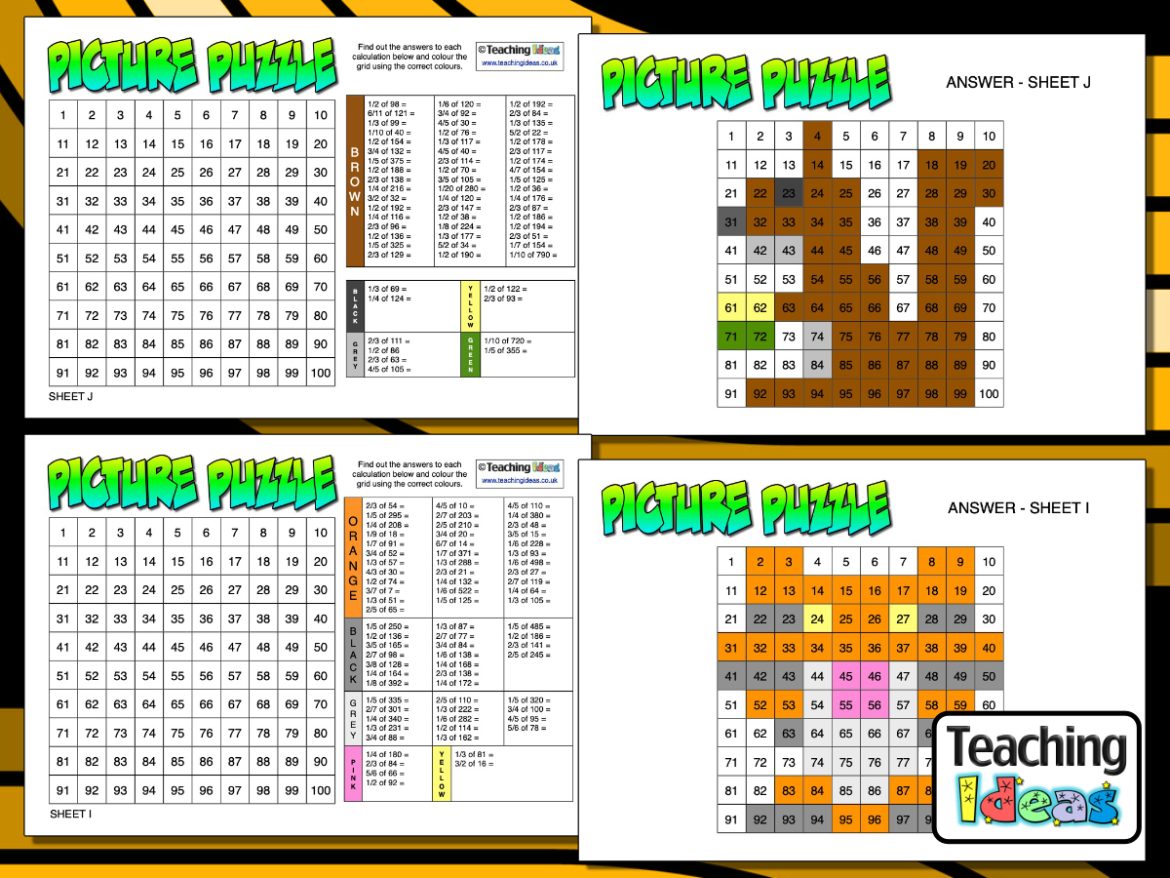
Our Picture Puzzle resources include a set of questions that your students can answer. When each calculation has been answered, they should colour the appropriate square on the grid with the correct colour… and when all of the questions have been solved, a picture should be revealed!
These resources can be used for class or homework challenges to support your Maths work.
Downloads:
Are you making a classroom display about the Vikings?
Here is a free banner for you to print and use. Let us know if you add it to a display board in your classroom!
Downloads:
Contributor:
Adrian Baker
I have used this award system for 13 years, and the kids really value it.
Children each have a small grid of 25 squares on their desks (made on the computer by the teacher). Squares are stamped when children are working quietly on a task, producing excellent work, doing homework, bringing a diary, consistently following class rules, doing extra jobs or being helpful, i.e. positive behaviours. Children also give them to each other for positive reasons at ‘warm fuzzy time’. I get them to write the person’s name and a reason on a slip of paper which is posted in a box. I then read them all out. When a student gets a grid filled, s/he gets a certificate, i.e. 25 Warm Fuzzies (which the children create) and, at certain times, a prize.
Then they aim for the next award, which is 50, 75, 100, 125, etc. I stress that it isn’t a race to get the most, but only a personal aim. The kids enjoy it, and it promotes positive behaviours and relationships, and they feel special when they receive them from others.


