Ages: 7-11
A selection of words and phrases which children can use within their own persuasive writing.
This poster can be used on a display board or as a reference mat for your students.

A selection of words and phrases which children can use within their own persuasive writing.
This poster can be used on a display board or as a reference mat for your students.
To get the children thinking mathematically first thing in the morning, I write a number on the board. It can be any number depending on the children’s abilities.
Then I ask them to tell me about the number, e.g. if the number was 12, they could tell me that 6×2=12 or it has 1 ten and 2 units etc…
Continue until they have run out of ideas. This is an excellent starter or filler.
These activities will teach the class about the properties of different materials. The activities are based on four worksheets which can be found below.
The activities (which might last for a few lessons) can be tried in two ways:
A) Split the class into four groups and ask each group to look at a different topic from the above four.
B) The whole class (split into groups) works on one of the above topics in each lesson.
Possible resources for each topic:
Hardness: | Strength: | Flexibility: | Magnetism: |
Lollipop Stick | Tissue paper | Elastic band | Silver coin |
Pencil | Kitchen towel | Aluminium foil | Copper coin |
Plastic Ruler | Writing paper | Cling film | Magnet |
Drinks can | Facial tissue | String | Rubber |
Rubber | Brown paper | Wool | Wool |
Plant pot | High-quality paper | Cardboard | Paper clip |
In addition, the hardness group might need some tools to scratch the materials (e.g. a screw, nail or a coin), and the magnetism group will need at least one magnet.
For an assembly about helping others / cooperation, tell the story about the two greedy brothers who were locked in a room with endless piles of their favourite foods.
The only rule was they had to eat the food with metre long spoons, holding the spoon at the very end. (Demonstrate how impossible this is by taping a spoon onto the end on a metre ruler).
They were so greedy they nearly starved until they figured out they could feed each other with the spoons! (Demonstrate with two children).
Explain that you can solve problems together if you look at things from a different viewpoint and that two heads are better than one!
A visitor has contributed a story which could be used with this idea:
There was once a king who was just and kind and honest. He ruled his land fairly. The kingdom was peaceful, prosperous and happy.
The king had just one problem: his brothers. These two men were cruel, selfish, and mean, but above all, greedy. At royal parties, they would push, poke and barge their way to the front of the queue for the buffet. Then they would gorge themselves, eating and drinking until they could hardly move.
One day, the king decided to do something about these two awful brothers of his. In the middle of the night, the royal guards woke the brothers and marched them downstairs into a small dark room they had never seen before.
Inside the room was a table. On the table was every kind of food you could imagine. There were pies and puddings, cake and crumbles, buns and pieces of bread, roasts and rolls, tarts and trifles, and dish upon dish of tasty things.
Standing next to this table heaving with goodies was the king, looking very stern. The king commanded his brothers that they must eat the food that the royal kitchens had prepared for them, but they must follow two important rules when doing so. The brothers looked at each other, then at the king, then at the food, their mouths watering.
“Rule number one,” the king went on. “You must only eat the food using the spoons I give you. Rule number two. You must only hold the spoon by the very end of its handle. Break either of these rules, and you will be thrown into the dungeon.” The king then walked out of the room, locking the door behind him. The two greedy brothers rushed forward to grab the spoons, pushing each other out of the way.
(At this point, get two children up onto the front to have a go at eating with the big spoons- desert spoons taped onto a metre stick work well. Give the children a couple of broken biscuits, which are easy to eat and can usually be found somewhere in the staff room)
However much they pushed, shoved and criticised each other, the two brothers were unable to eat even one crumb of the delicious food. It was only after three days of trying, when they were weak with hunger and half-mad with frustration, that they came up with the idea of helping each other. Only by cooperating, taking turns and carefully feeding each other, were they able to get any food at all.
The next day, the king opened the doors of the brothers’ room and found two very different men inside. They had learned how to think of others, how not to be selfish and how to work as a team.
I wonder if you can do that today?
 About 18 months ago, my class and I sent Pompey Pete, a little bear dressed in holiday gear with a camera etc., on a world tour. Being Portsmouth-based and Pompey being the local name for our football team, we decided he had to be called Pompey Pete!
Pete went accompanied by letters from all my Year 4/5 children, a photograph of the class, some maps, postcards and info about our school and Portsmouth etc. in a journal. I did a cover letter explaining the idea behind Pete’s trip and asking for a postcard to be sent from his holiday destination with some info about the weather etc. Further info, postcards, sweet wrappers or anything to do with his holiday destination that was easy to stick in or include with his journal was requested.
Some friends brought back bits so that the children could try them out first-hand. The recipients started off as friends, and a list of worldwide addresses for willing participants was added to the journal so that nobody was stuck for passing on Pete.
His first trip was to Abu Dhabi, and within about ten days, we had a postcard back. We tracked his journey on a world map and blu-tacked the postcards around the map, having taken a photocopy of the text so that both picture and text could be viewed together. Next was a trip to the States and Christmas in New York. A trip to Macy’s and the Christmas Parade etc., followed, details briefly sent on a postcard, from cold NY to hot and blistering Texas next. The journeys continued – Canada, the far east, Spain, France etc. and very conveniently to Amsterdam when we did work on Anne Frank!
The journal has come back full of photos of Pete and his holiday companions etc. He is off again in September to destinations unknown. Have you ever tasted Banana Catsup from Abu Dhabi? My class did – banana ketchup to you and me! Kit-Kats with Arabic writing as well as English. You name it, they’ve picked up lots of geography about real live people, food, weather etc. and got photos too.
Pete’s cousin, Sailor Sam (the naval connection), is currently doing a tour of local schools in Portsmouth. He should have come back to St. Swithun’s last month but is probably lurking in a cupboard somewhere! We were more adventurous this time and made a class video too.

What is a Rebus?
A REBUS is a representation of a name / word / phrase using pictures.
Look at the following images and try to work out what they mean…


HIGH HIGH
Answers:
More Rebuses:
A worksheet that contains a further 24 rebuses (and their answers) can be found by clicking below.
How Can Rebuses be Used in the Primary Classroom?
1) Give the children a copy of the worksheet and ask them to try and work out the answers. You will, of course, need to explain the concept first, showing them some examples (with their answers).
2) Have a “Rebus of the Day competition”. This would be similar to the “Question of the Day” activity, except that you show the children a Rebus, and they have to try and work out what it means.
3) Draw some rebuses on the board and ask the children to work out the answers during registration time.
4) Spend a lesson discussing and working out lots of rebuses. When the children are comfortable with them, they might be able to make some of their own.
5) Make a “Rebus Puzzle Book”. Each child can make a page on which there are a number of their favourite rebuses. They could also include some of their own made-up rebuses. Remember to make an “Answers” section in your book so that readers can check their answers.

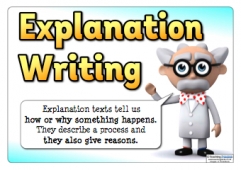
Teaching your children how to write explanation texts? Use our handy pack of teaching and activity resources! This PDF includes:
These resources are part of the Explanation Writing Pack. Find out more on our Teaching Packs site.
I play this game with my Foundation children.
Spread 4 different colour hoops around the floor space. Children move around the space (run, skip, crawl etc.) until the teacher shouts “hoop”.
The adult covers their eyes and counts slowly to 3. Children have this time to run to a hoop.
The adult says the colour of one hoop. Everyone in this hoop is out. Repeat until you have a winner.
Children who are out can close their eyes and select the hoop colour.

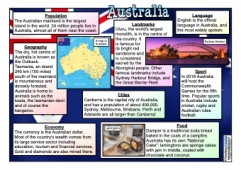
Teach your children about Australia with our free fact file! It is available at two different levels of difficulty and includes information about:
Use this as a reference resource for children or print it and add it to a classroom display board! Could your children make some quiz / comprehension questions based on the facts shown?
This file is part of our Commonwealth Teaching Pack. Find out more on our Teaching Packs site.
Objective: The students will understand what a resist is and know and recognize six basic shapes (circle, square, rectangle, triangle, oval, and diamond) and how to make patterns.
Materials: Crayons, White construction paper, Newspaper, Water, Cans, Watercolours and Paintbrushes
Visual Resources: Large cut-out shapes, labelled and posted on the board. Post large art paper for the teacher to model along with students. Post an example of a finished product.
Procedure:
Assessment: Review with the students the six types of shapes and what the terms resist, pattern, and rhythm mean. Have the students give examples from their pictures to the class of the shapes they used and how the resist method affected their paintings.